8/657%of cycle on swing
Eight days on, six off
A relatively short swing with six rostered days away from site. Travel timing can reduce the usable break at home.
Ask before accepting
Does the swing stay on days, rotate to nights, or contain both?


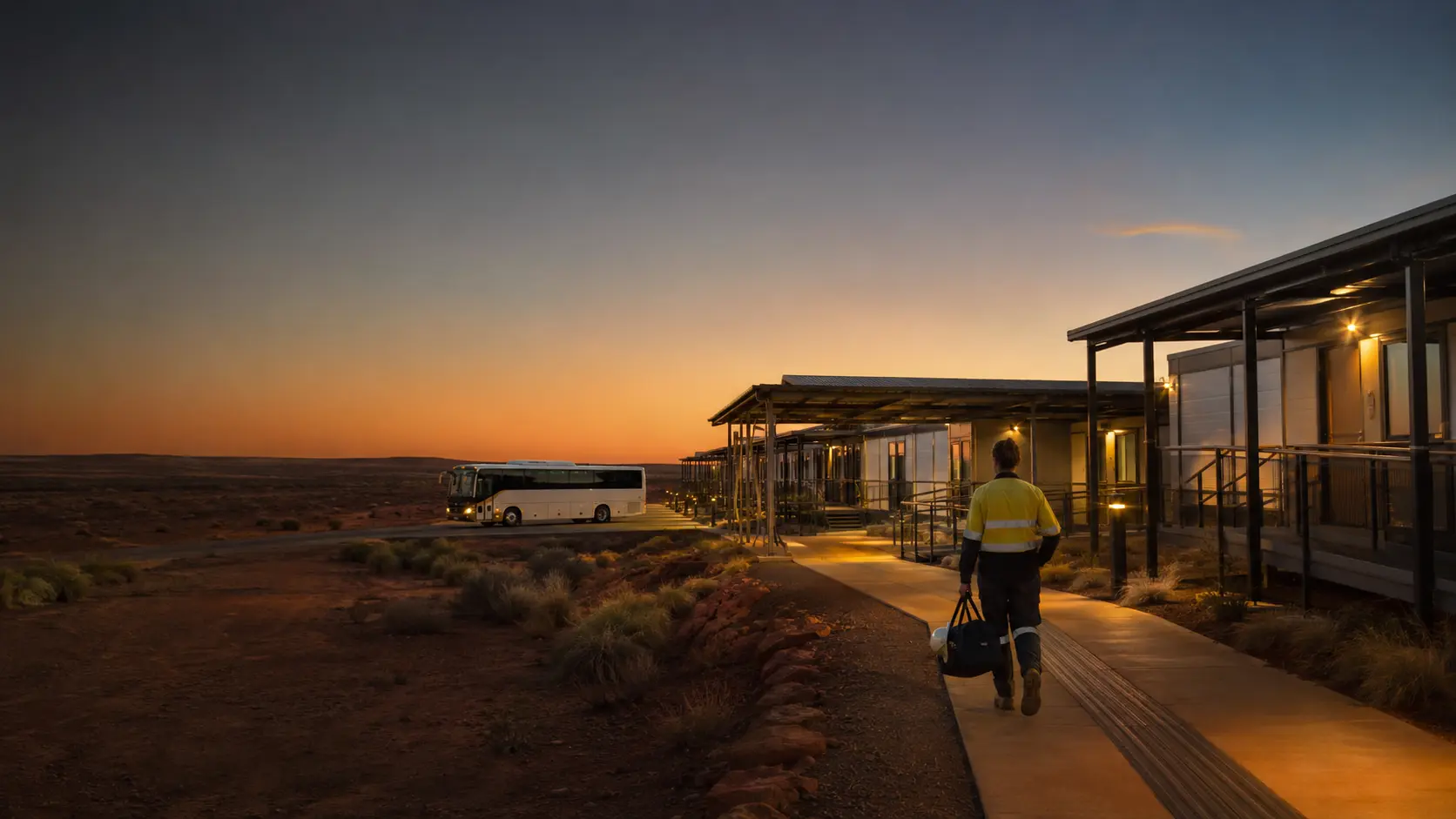
FIFO life in Australia
Rosters, flights, camp routines, sleep, relationships and the trip home all shape the job. This guide explains the practical life around the worksite.
Original conceptual editorial visual · The FIFO Hub · AI-assisted · not a named camp or employer
The honest starting point
A mine employee on an 8/6 roster, a shutdown worker moving between short campaigns and a construction worker on 2/1 can all say they work FIFO. Their time away, job security, pay structure, camp routine and recovery demands may be completely different.
The useful question is not simply, “Can I handle FIFO?” It is whether a particular role, roster, travel arrangement and camp work with your health, responsibilities and reasons for doing the job.
A roster that looks attractive on a calendar can feel different after early flights, twelve-hour shifts, night work and the transition back home.Why mining towns have a ghost population
Roster comparison
These are representative patterns, not promises. Actual hours, travel days, day/night rotation, leave and swing changes depend on the employer, project and role.
A relatively short swing with six rostered days away from site. Travel timing can reduce the usable break at home.
Does the swing stay on days, rotate to nights, or contain both?
Even time on paper. Some roles alternate day and night swings, which can make body-clock transitions a major part of the break.
How are day-to-night transitions rostered, and when do flights occur?
A longer block of consecutive workdays. It may suit project and contractor work, but recovery and home responsibilities need realistic planning.
How many consecutive shifts, what are the hours, and is overtime expected?
A long swing followed by an even break. The extended time away can be demanding even when the annual split looks balanced.
Is the role permanent, casual, contract or project-based, and how is leave handled?
Roster mathematics: “On swing” percentages describe the repeating calendar pattern only. They do not calculate paid hours, annual earnings, leave, travel time, overtime, shutdown gaps or the quality of time at home.
Roster maths
These figures assume every rostered on-day contains 12 paid hours and the pattern repeats continuously across an average 365.25-day year. “Per week” is the long-run average across both work and R&R—not the hours worked during seven consecutive days on site.
| Roster | Pattern | Paid hours per swing | Cycle-average hours per week | Average annual roster hours |
|---|---|---|---|---|
| 8/6 | 8 on · 6 off | 96 hours | 48 hours | 2,504.6 hours |
| 7/7 | 7 on · 7 off | 84 hours | 42 hours | 2,191.5 hours |
| 2/1 | 14 on · 7 off | 168 hours | 56 hours | 2,922.0 hours |
| 2/2 | 14 on · 14 off | 168 hours | 42 hours | 2,191.5 hours |
The table converts the average annual roster hours above into a gross annual equivalent. It is a comparison tool, not a guaranteed salary or take-home-pay estimate.
| Roster | $50/hour | $60/hour | $70/hour | $80/hour | $90/hour |
|---|---|---|---|---|---|
| 8/6 | $125,229 | $150,274 | $175,320 | $200,366 | $225,411 |
| 7/7 | $109,575 | $131,490 | $153,405 | $175,320 | $197,235 |
| 2/1 | $146,100 | $175,320 | $204,540 | $233,760 | $262,980 |
| 2/2 | $109,575 | $131,490 | $153,405 | $175,320 | $197,235 |
Not a guaranteed salary: This simple model treats the quoted rate as one flat rate for every calculated roster hour. Actual ordinary hours, unpaid breaks, overtime, weekend or night penalties, allowances, casual loading, paid leave, public holidays, superannuation, travel, training, stand-downs and roster changes can produce a different result. Check the employment contract and applicable award or registered agreement, then use the Fair Work Pay and Conditions Tool where relevant.
Same numbers, different body clock
An 8/6 roster can mean fixed days, alternating day and night swings or a change within the same swing. Those are different fatigue and home-life propositions.
Every swing remains on day shift. This removes day/night rotation but does not remove fatigue from early starts, long shifts, heat, travel or overtime.
One swing on days and the next on nights. The break may include both recovery from the last pattern and preparation for the next one.
Days and nights occur within the same swing. Ask how the changeover, recovery period and transport are designed before assuming the roster label tells the whole story.
Start dates can be staggered and a relief worker may cover leave or different crews. Predictability, room allocation and flight times can vary more than on a fixed crew.
The advertised pattern may be a campaign plan rather than an ongoing cycle. Extensions, weather, handback timing and gaps between jobs can change the lived roster.
Mining work can use daily residential travel, drive-in drive-out or bus-in bus-out arrangements. The fatigue and home-time calculation must include the real commute.
The seven questions
Point of hireWhich airport or location does the employer's travel responsibility begin and end?
Travel daysDo flights happen on workdays, break days or a mixture—and how does that affect usable time at home?
Shift hoursWhat are the ordinary hours, breaks, pre-start expectations and likely overtime?
Days and nightsIs the roster fixed, rotating or split within a swing? How often does the pattern change?
Employment typePermanent, maximum-term, casual, labour hire and project work can treat leave and gaps differently.
Camp and roomWhich village, what facilities, and is the room permanent, shared between swings or reassigned?
VariationCan swings be extended, shortened or moved? What notice is normally given?
Roster language
The same term can be used differently between operators, contractors and projects. Ask what it means in the actual offer.
Roster changes: Fair Work guidance says employers proposing a change to a regular roster or ordinary hours generally need to provide information, invite views and consider the impact. The applicable award or registered agreement can set additional rules, while irregular or unpredictable hours may be treated differently.
Travel days
Flights, buses, queues, baggage, delays and the trip to the point of hire can turn a nominal break into less recovery than the roster suggests.
Final sleep, packing and travel to the point of hire
Check-in, screening, baggage and possible delays
Charter or commercial travel to a regional airport
Transfer to village, site or mobilisation location
Room allocation, induction, meals and next-shift preparation
Keep identification, licences, medication in original packaging, essential PPE instructions, chargers and one change of clothes accessible. Follow airline and employer rules.
Check charter limits, dangerous-goods restrictions, tools, aerosols and battery requirements before packing. Rules may differ from a normal commercial flight.
If you are too fatigued to drive safely after travelling, do not simply push through. Use your employer's fatigue process and arrange a safer option.
Camp life
“Camp” can mean an established village with extensive facilities or temporary project accommodation with fewer options. Ask what the actual village provides.
A large, long-running accommodation village may have permanent rooms, multiple mess services, a gym, recreation facilities, reception, security and an on-site medical or wellbeing service.
A project camp may expand and contract with mobilisation. Rooms and services can be modular, occupancy can change quickly and the village may be further from the operating site.
Smaller field camps can have limited connectivity, shared facilities and different transport, power, water and emergency arrangements. Confirm the actual standard before travel.
Some crews use a motel, lodge or company house in a regional town rather than a mine village. Meals, transport, laundry, privacy and conduct arrangements can be different.
What you may find
Usually a compact private room; ensuite, storage, fridge, desk, blackout quality, noise and permanent-room arrangements vary.
Meals are normally provided during service windows. Choice, nutrition, takeaway crib options and night-shift access differ by village.
Some workers pack food at the mess; others receive crib packs or use workplace facilities. Confirm what your site provides.
Shared washing machines and dryers are common. Bring a simple laundry routine and label personal items if the village recommends it.
Facilities may include a gym, pool, courts, walking areas or recreation rooms. Opening hours and quality vary.
Some camps provide licensed alcohol service and others are dry. Site alcohol limits, testing rules and fitness-for-work requirements still apply.
Buses may connect the airport, village and work areas. Missing the bus can be more than an inconvenience, so learn the system early.
Reception, security, village management, medics, supervisors and EAP contacts form different parts of the support network.
First arrival
The first evening is easier when the essentials are located before dark, fatigue or a very early bus.
Show the required identification, receive the room or village access details and confirm the checkout or room-change process.
Check the door, lock, air-conditioning, smoke alarm, linen, bathroom and any pre-existing damage. Report faults rather than improvising repairs.
Locate the evacuation diagram, muster point, alarms, emergency number and route from the room in darkness.
Find the mess, crib collection, buses, laundry, drinking water, gym, reception, medic and any designated smoking or social areas.
Confirm wake-up time, bus stop, shift start, induction or pre-start location, PPE and what food or water is taken to work.
Store identification, medication, keys and valuables safely. Use the approved channel for room, security or welfare concerns.
Camp etiquette
Camp is not “off policy”
Alcohol, drugs, prescription effects, fatigue, harassment, visitors, photography and conduct can remain subject to employer, client and village rules outside the physical work area. Testing may occur at camp or before site access.
Read the FIFO medicals and testing guide →Camp questions
There is no universal camp standard. The mobilisation pack and village rules are the source for your room and swing.
Not always. A private room is common in established villages, but ensuite facilities, permanent allocation and storage vary. Some rooms are reassigned or used by the opposite roster when the worker is away; confirm the actual arrangement.
Meals are commonly supplied through the village mess, with crib or takeaway arrangements for the shift. Service hours, night-shift access, dietary options and any charges depend on the employer and camp.
Many do, but the replacement schedule and whether towels, toiletries or laundry bags are supplied varies. Read the mobilisation information before packing extras.
Many established camps offer Wi-Fi or mobile coverage, but speed, coverage, login rules and reliability vary. Do not rely on camp internet for urgent family or financial arrangements without a backup plan.
Some villages have a licensed wet mess, some impose limits and some are dry. Employer and client fitness-for-work rules can apply at camp and before the next shift. Never assume the presence of a bar changes the testing policy.
Usually only authorised workers and approved visitors can access a village. Do not invite or transport another person without the required permission and access process.
Report noise, air-conditioning, lighting, hygiene, pest or room-security problems promptly. Accommodation issues that reduce sleep opportunity can become fatigue and safety risks.
Some workers keep a permanent room; others remove belongings or use allocated storage while the room is reissued. Confirm the room-clearance, storage and prohibited-item rules before leaving site.
Fatigue is a work-health risk
Safe Work Australia describes fatigue as physical, mental or emotional impairment that can prevent people functioning safely. It can arise from work and non-work factors.
Shift length, night work, consecutive shifts, overtime, breaks, task demands and roster changes.
The actual time left for travel, meals, washing, wind-down and sleep between duties.
Room noise, light, temperature, body-clock timing, health, stress and personal choices can all affect sleep.
Fatigue can reduce attention, judgement, reaction time, communication and the ability to recognise changing risk.
Driving, mobile plant, electrical work, lifting, heights and other safety-critical tasks increase the consequence of an error.
Breaks, rostered time off, sleep, workload adjustment, support and medical assessment where needed.
Work and site controls
Worker actions
Shift-work sleep
The Sleep Health Foundation advises that many healthy adults need around seven to nine hours of sleep in each 24-hour period, although individual needs vary.
Use the room's blackout controls or an eye mask where allowed. Reduce bright light and stimulating screens close to sleep.
Use approved earplugs or steady background noise if helpful, while ensuring required alarms and emergency warnings remain audible.
Set a comfortable room temperature and report air-conditioning, bedding or noise faults that interfere with sleep.
Keep a repeatable wind-down and sleep schedule for each shift type where practical. Plan the transition to days off.
Its effects can last for hours and vary between people. Consider timing it so it supports the shift without undermining the next sleep.
Alcohol can reduce sleep quality. Discuss melatonin, sleeping tablets or medication effects with a health professional rather than improvising.
Health boundary: This is general information, not a diagnosis or personal treatment plan. Use your site's fatigue and fitness-for-work procedures. For persistent fatigue or sleep concerns, speak with a GP or appropriate health professional.
Wellbeing on swing
Site facilities, health needs and shift timing differ. A simple routine that survives busy days is usually more useful than an ambitious plan that lasts two shifts.
Protect the main sleep window first. Treat room preparation and wind-down as part of the shift routine.
Use the options available to build regular meals that support the shift. Keep lighter choices available when eating close to sleep.
Follow site heat and hydration controls. Needs vary with work, weather, health and PPE; raise concerns early.
Short, repeatable exercise or mobility work can be easier to sustain than trying to train hard after every long shift.
Agree on realistic contact with home and keep some connection with people on site. Isolation can build quietly.
Know the medic, EAP, supervisor, peer-support and external options before you need them.
A 2018 WA Government-funded study involving more than 3,000 FIFO workers and family members reported high psychological distress among 33% of FIFO workers, compared with 17% of non-FIFO workers. The finding supports better work design, accommodation, culture and access to support; it does not predict any one person's experience.
Read the WA Government summary ↗Relationships and returning home
The worker may arrive depleted and ready to switch off. The household may be ready to reconnect, share decisions or hand back responsibilities. Neither need is automatically wrong.
Agree who handles bills, appointments, school, pets, maintenance and emergencies. Share the roster and travel details.
Set a realistic rhythm around shifts, sleep and home routines. Leave room for urgent calls and for days when one person has little energy.
Discuss what needs attention now, what can wait and whether a short recovery window is practical. Avoid making the whole break a delayed task list.
Time with children, partners, friends and alone all matter. Plan enough structure to reconnect without scheduling every hour.
Confirm the next travel day, unfinished priorities and who carries each responsibility during the next swing. Do not leave the whole handover until the airport.
Money and purpose
FIFO income can drift into higher spending because the work feels costly and the break feels like a reward. A clearer plan ties the roster to a reason: debt reduction, a home deposit, training, family security, investment or a defined exit point.
General information only. Check your contract, applicable award or agreement, payslips, tax position and personal financial circumstances with qualified sources.
First-swing checklist
Use employer mobilisation instructions as the authority. This expanded checklist helps you prepare and ask; it does not override airline, site, medical or emergency procedures.
Packing framework
Start with the employer list. Add only what the airline, village and worksite allow.
Check CASA dangerous-goods guidance ↗Photo ID, booking, licences, mobilisation contact and any documents specifically requested at check-in.
Phone, charger, correctly packed power bank, medication, glasses and essentials needed if checked baggage is delayed.
Only the PPE, workwear, boots, tools or equipment the employer tells you to bring. Confirm what is supplied.
Toiletries, casual clothes and approved sleep supports such as an eye mask or earplugs. Check linen and towel supply first.
Medication in original labelled packaging, enough supply for disruption, and any required confidential declaration evidence.
Shared itinerary, emergency contact route, bills and household handover completed before the flight.
Do not guess about medicals or prescriptions. Carry medication correctly, use the approved declaration channel and understand the screen-to-confirmation process before mobilisation.
Open the medicals, PEM and testing guide →Support in Australia
Use your site medic, supervisor, EAP, GP or another trusted service. If life is in immediate danger, call 000.
Contact details checked 30 August 2026. Call 000 for immediate danger or urgent medical help.
Sources and deeper reading
Source-checked 30 August 2026. Workplace controls, health needs and employment arrangements must be confirmed for the actual person, role and site.
Current national guidance on work design, shift patterns, breaks, recovery and shared consultation.
The 2025 model Code of Practice for eliminating or minimising work-related fatigue risk.
WA's FIFO-specific code covering work design, accommodation, culture, psychosocial hazards and recovery support.
Summary of the 2018 government-funded study involving more than 3,000 FIFO workers and family members.
Australian information on body-clock disruption, sleep, concentration and drowsy driving.
Current practical guidance on sleep scheduling, room conditions, caffeine, alcohol, light and transition days.
Government-funded health information, when to seek medical help and the 24/7 health advice line.
Industry-specific resources and a free confidential 24/7 helpline for mining workers and families.
Current guidance on roster definitions, changes and consultation, subject to the applicable award or agreement.
WA's code of practice for facilities and work environments covered by the general and mines WHS regulations.
Check dangerous-goods rules for power banks, batteries, aerosols, tools and other items before air travel.
Fitness-for-work duties include prescribed and over-the-counter medicines as well as alcohol and other drugs.