Operator assistance
Collision warnings, proximity detection, fatigue monitoring, machine guidance and automatic braking.
Human role
A person still drives or operates the machine and remains responsible for the operating task.


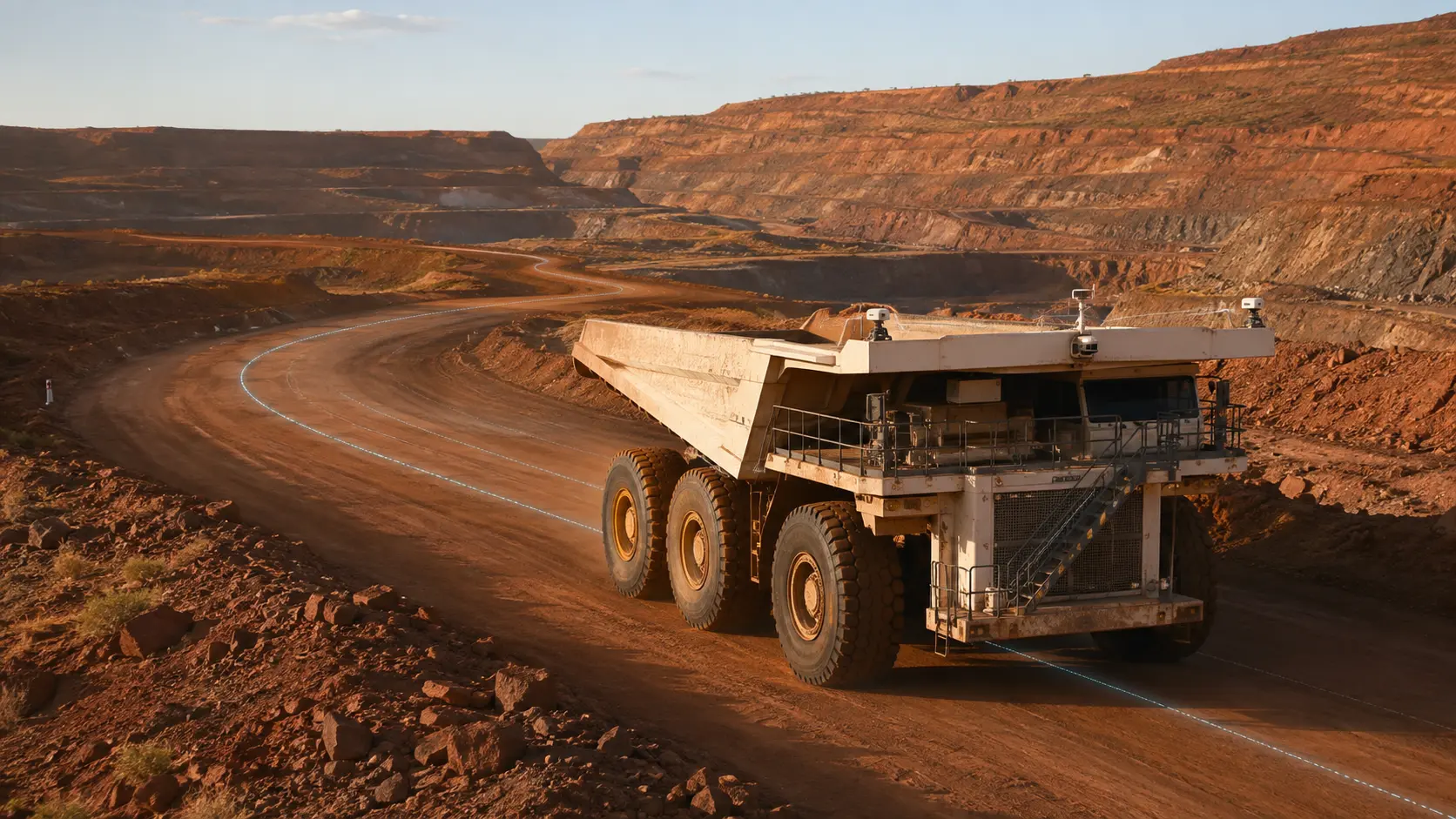
Australian mining automation & technology
Understand autonomous haulage, remote operations and the technology changing work from pit to port—without the hype or the assumption that every site works the same way.
Original conceptual editorial visual · The FIFO Hub · AI-assisted · not a specific OEM model or mine site
The useful starting point
An autonomous haul truck is only one visible part of a larger system. It depends on an accurate mine map, positioning, onboard sensors, wireless communications, fleet-management software, loading-tool interaction, maintained roads, controlled operating zones and trained people who can supervise and respond.
That distinction matters. A truck may drive without a person in the cab, but people still plan the work, maintain the machine, control access, manage exceptions and verify that the system is safe to operate.
Driverless does not mean people-less. It moves people away from one task and creates a different set of operating, technical and maintenance tasks around the fleet.
Use the right language
The exact capability and approved operating model vary by machine, supplier and site. These are practical descriptions, not formal certification levels.
Collision warnings, proximity detection, fatigue monitoring, machine guidance and automatic braking.
A person still drives or operates the machine and remains responsible for the operating task.
A dozer, underground loader, drill or other machine is controlled from a console away from the immediate hazard.
The operator directly commands the machine, but is removed from noise, dust, vibration or a hazardous work area.
Onboard systems automate parts of the cycle while an operator supervises, intervenes or performs precision tasks remotely.
One person may manage more than one machine, depending on the task, system and approved operating model.
Haul trucks navigate assigned routes, respond to obstacles and complete defined load-haul-dump movements without a driver in the cab.
Controllers supervise the fleet and manage exceptions; planners, maintainers and field teams keep the operating environment ready.
Autonomous haulage system
This conceptual diagram explains the control layers. It is not an OEM architecture, site procedure or safety-control specification.
The fleet system assigns a destination and approved path using the mine plan, operating zones and material movement priorities.
GNSS, maps, object detection and onboard sensors help the truck understand where it is and what is around it.
Drive-by-wire interfaces manage steering, braking, propulsion and retarding within the system's operating rules.
The truck coordinates with loading tools, dump points, intersections, staffed equipment, light vehicles and other autonomous machines.
Controllers monitor the system, manage exceptions and coordinate field response. The fleet is autonomous; it is not unmanaged.
Komatsu FrontRunner AHS
Komatsu describes FrontRunner trucks as autonomous rather than remotely driven. A controller supervises fleet activity and exceptions while the system assigns routes, coordinates loading and monitors machine state inside a controlled operating area.
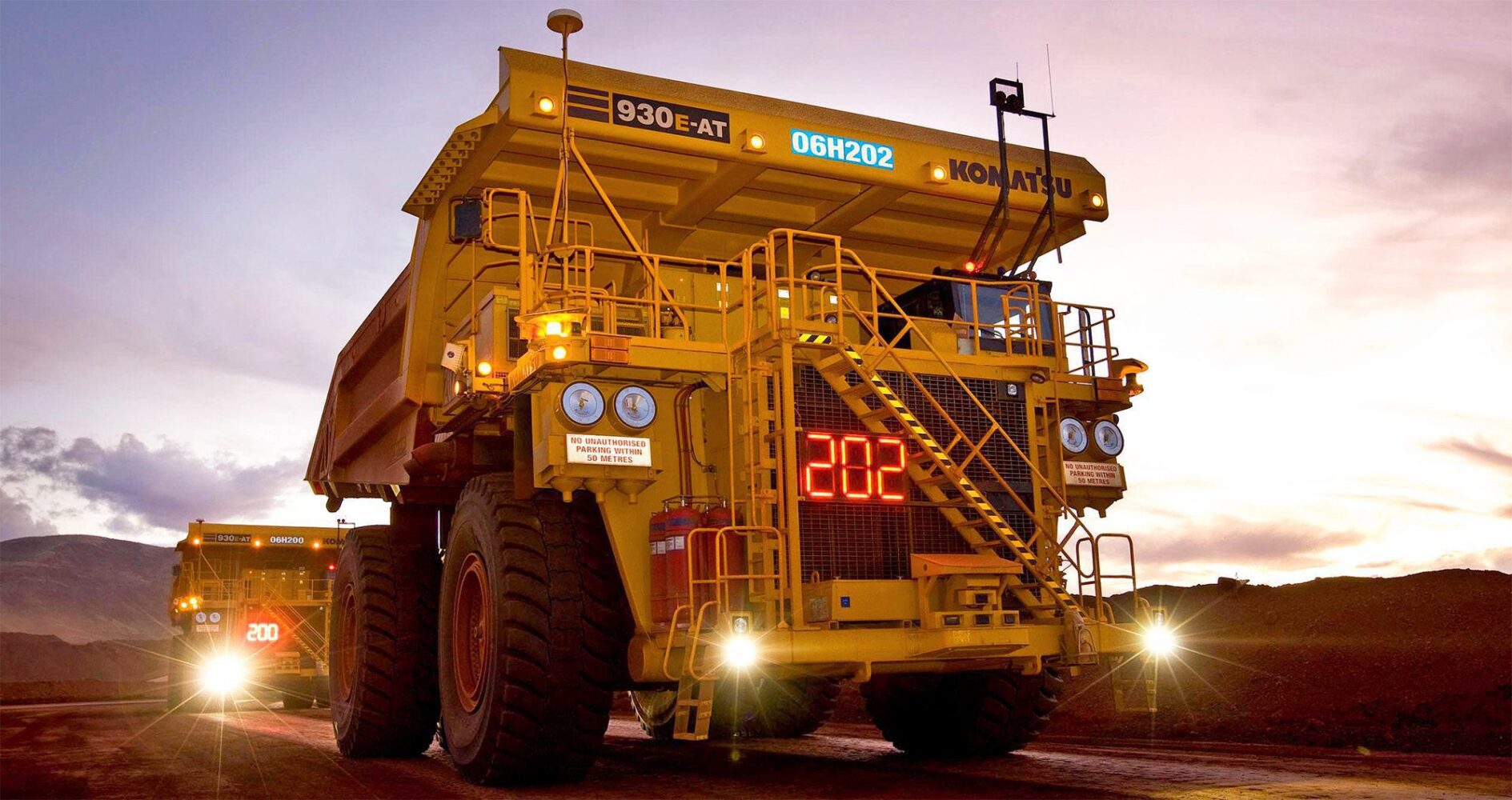
Accurate haul roads, intersections, load areas, dump locations and boundaries give the system a defined environment in which to operate.
Central software allocates the next destination and route using production priorities, traffic, equipment state and mine-plan information.
Onboard positioning, machine control and drive-by-wire interfaces manage steering, speed, braking, propulsion and retarding along the approved route.
The loading-tool operator works through the system to spot the truck, load it and release it for the next stage of the cycle.
Onboard detection systems can slow or stop the truck when an object is detected. Site separation and access controls remain essential.
Controllers monitor the fleet and coordinate exceptions. Field technicians, maintainers, planners, survey and OT teams keep the wider system ready.
Important boundary: This is a general explanation based on Komatsu's public system material. It is not a site operating procedure, a statement about a specific mine or a substitute for authorised autonomous-zone training.
What the machine can—and cannot—do
Australian deployments
Figures are operator or supplier reported and checked 29 August 2026. Fleet numbers and operating scope can change.
Rio Tinto also reports 40 autonomous production drills across seven sites. AutoHaul links its mines and ports through a long-distance autonomous heavy-haul rail system supervised from Perth.
Open official source ↗Jimblebar became BHP's first fully autonomous truck operation. South Flank's five autonomous operating zones were designed to work with around 185 pieces of ancillary equipment.
Open official source ↗The HIVE in Perth coordinates autonomous haulage with processing, rail, port, scheduling and energy systems. Fortescue reports more than 80% of haul trucks at Solomon operate autonomously.
Open official source ↗Epiroc reports the mixed-fleet LinkOA deployment had moved more than 300 million tonnes autonomously. It is an important Australian example of retrofitting autonomy rather than replacing every truck.
Open official source ↗Independent editorial note: Inclusion documents Australian automation activity. It does not imply endorsement, partnership or a comparison of operator safety performance.
Beyond driverless trucks
The human role changes differently in each system. Some machines are autonomous; others remain directly controlled from a safer or more central location.
Driverless rigid-frame trucks complete assigned haul cycles inside controlled operating zones.
Mine control, mobile maintenance, AHS technicians, loading-tool operators
Remote consoles plan and supervise repeatable blast-hole drilling while crews manage drill patterns, consumables, ground conditions and exceptions.
Drill controllers, drill fitters, drill-and-blast teams, survey and planning
Train control, onboard cameras, signalling and network systems move ore over long distances under remote supervision.
Network controllers, rail signalling, communications, track and rollingstock maintenance
Machine positioning, 3D sensing and control logic support precise stockyard and shiploading movements.
Port controllers, E&I technicians, electricians, mechanical teams and planners
Operators control dozers or underground load-haul-dump machines from a safer location; some travel functions may be automated.
Remote operators, field support, geotechnical teams and maintainers
Detection, proximity awareness and automatic intervention reduce mobile-equipment interaction risk. This may assist a driver or sit inside an autonomous system.
All mobile-equipment users, control teams, trainers and system technicians
Drones, remotely operated vehicles and purpose-built robots inspect highwalls, confined or difficult-to-access areas and machine components.
Inspectors, drone pilots, engineers, NDT and maintenance specialists
Sensors, historians, machine learning and digital models help teams identify abnormal behaviour, predict degradation and optimise the system.
Reliability, condition monitoring, data, process control and maintenance teams
Remote operations centres
Perth-based centres operated by major Pilbara miners bring mine control, processing, rail, port and planning information together. The benefit is not simply distance. It is the ability to see constraints across the system and coordinate decisions.
Explore the control systems guideCareers around automation
Titles vary by operator and supplier. Some roles are site-based, some are Perth-based and others move between control rooms, workshops and operating areas.
Supervises fleet state, priorities and exceptions; coordinates with field teams, loading tools, dispatch and maintenance.
Tests sensors, onboard hardware, networks and machine interfaces; diagnoses faults and confirms the truck can safely return to service.
Maintains the mechanical, electrical and hydraulic truck beneath the autonomy layer, with added attention to sensors, harnesses and system integrity.
Supports radio, wireless, fibre, servers, positioning and operational-technology networks that connect machines and control rooms.
Works across machine control, software configuration, functional safety, change management, system interfaces and validation.
Builds accurate plans, routes, boundaries and spatial data so automated equipment receives a workable operating environment.
Combines events, alarms, condition data, work history and production context to find repeat problems and improve availability.
Builds competence, verifies operating discipline, investigates events and helps people work safely around automated equipment.
For current operators and trades
Hazard awareness, radio discipline, production understanding, quality handovers, mechanical sympathy and calm response to abnormal conditions.
Fleet-management screens, event logs, telemetry, basic networks, sensor fault-finding, system recovery, data interpretation and change control.
The machines, operating zones, control systems and interfaces you worked with; the decisions you owned; and the faults, improvements or recoveries you helped deliver.
Safety around automated mining equipment
Western Australia's autonomous mining guidance emphasises a risk-based system approach, including competent people, integration with staffed operations and confirmation that the system performs as designed.
Know the site's access, positive-communication and equipment-interaction rules before entering or working near an autonomous area.
Treat mode, alarms, permissions and machine status as safety-critical information. Never assume a stopped machine is isolated or safe to approach.
Staffed equipment, light vehicles and pedestrians create interaction risks that require separation, detection and disciplined communications.
Sensor cleaning or repair, functional testing, software/configuration changes and return-to-service work require approved isolation and verification.
Dust, weather, road changes, positioning or network problems can affect system performance. Escalate abnormal behaviour through the site's process.
Control-room workload, alarm handling, fatigue, situational awareness and handover quality remain important even when the cab is empty.
Safety boundary: This guide provides general awareness only. It does not replace site induction, traffic-management plans, autonomous operating-zone rules, isolations, permits, OEM instructions, competency assessment or direction from authorised site personnel.
What comes next
The next challenge is not only making a truck drive itself. It is coordinating energy, charging or dynamic power, mixed equipment brands, production priorities and human access across a changing mine plan.
Official sources
Source-checked 29 August 2026. Statistics describe the date and scope stated by each source and may change as fleets expand or are reconfigured.
Current overview of autonomous haul trucks, AutoHaul, drills, operations centres and robotic inspection.
Current Pilbara fleet, drilling, rail, mine and port context.
BHP's first fully autonomous truck operation and reported heavy-vehicle risk reduction.
The 2023 completion of five autonomous operating zones and conversion of 41 Komatsu 930E trucks.
WAIO drill fleet and remote-control context reported in 2022.
How BHP's Perth IROC connects mine, process, rail and port activities.
How the HIVE coordinates Fortescue's Pilbara supply chain.
Reported scale of Roy Hill's converted autonomous fleet at January 2026.
OEM explanation of fleet control, maps, loading interaction and onboard obstacle detection.
OEM overview of autonomous haul-cycle tasks and integrated fleet operation.
WA guidance on managing risks in mobile autonomous and mixed mining operations.