

integrated operating network
Company knowledge base · Rio Tinto Iron Ore
Rio Tinto Pilbara Iron Ore
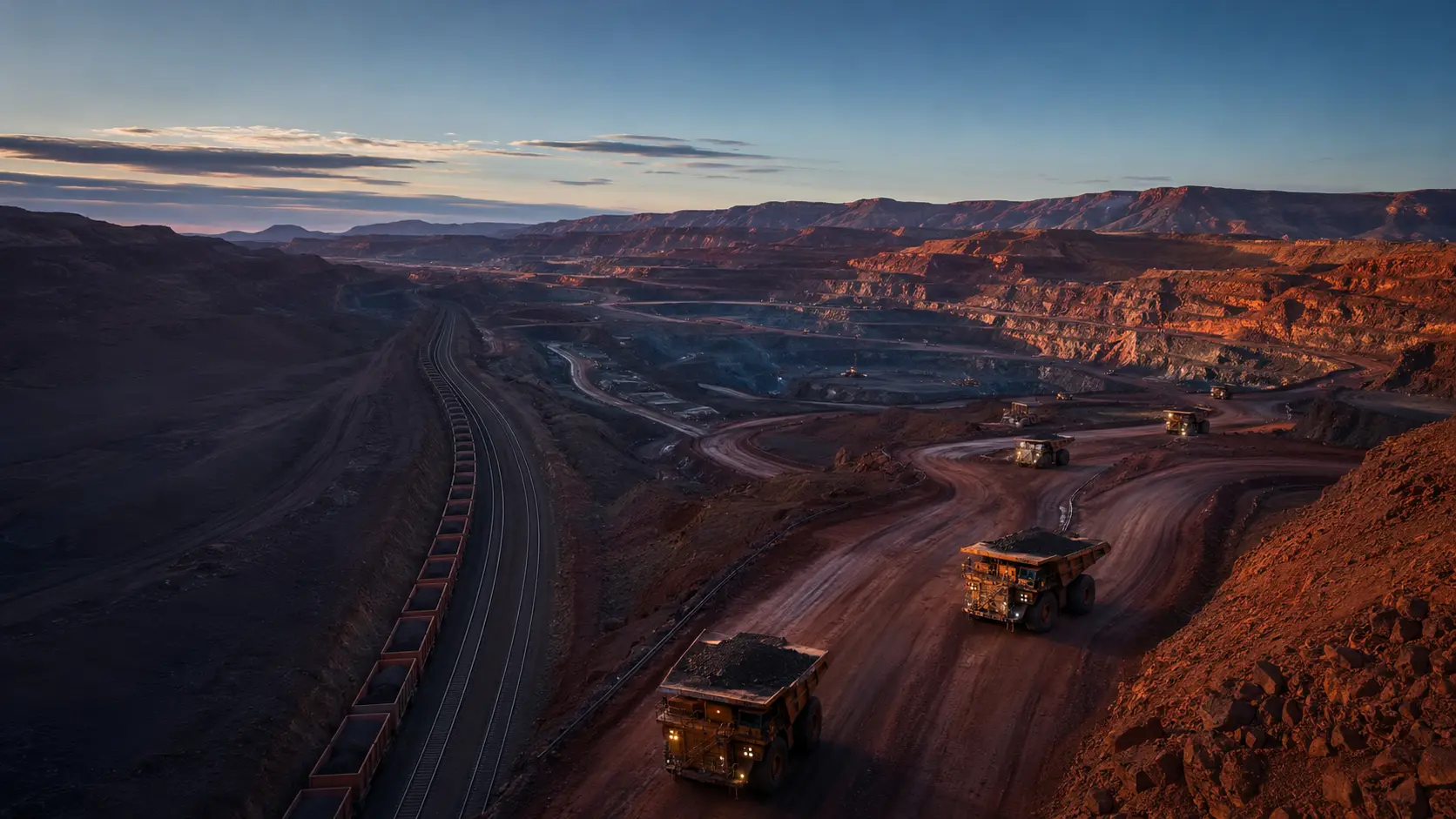
18 mines. Four port terminals. Nearly 2,000 kilometres of rail. Six decades of Western Australian iron ore exports.
Rio Tinto Iron Ore at a glance
The Pilbara system that helped reshape Western Australia.
Rio Tinto's wider corporate history reaches back to the Rio Tinto Company formed in 1873. Its Western Australian iron ore story began through Hamersley Iron, with the first shipment leaving Dampier for Japan in August 1966.
Today, Rio Tinto Iron Ore, commonly shortened to RTIO inside the industry, operates an integrated network of 18 mines, four terminals at Cape Lambert and Dampier, and Australia's largest privately owned rail network.
terminals at two locations
kilometres
of Pilbara haul trucks
First Pilbara shipment from Dampier
Paraburdoo and Robe River operations
Marandoo begins operations
Hope Downs 1 starts production
AutoHaul autonomous rail launches
Gudai-Darri first production
Eight billion tonnes shipped
Operating system
Explore the hubs, mine, port and future project profiles.
The database groups Rio Tinto's 18 mines into their operating hubs. Map coordinates are approximate regional references and not intended for navigation.
REGIONAL SYSTEM MAPPilbara, Western Australia
Approximate locations — not for navigationMine hub
Brockman
A major western Pilbara production region centred on Brockman 4 and connected operationally with Greater Nammuldi.
Open site profile →11 PROFILES
Brockman
Western Pilbara, north-west of Tom Price
- Product
- Hematite iron ore
- Opened
- Brockman 4 opened 2010
Greater Nammuldi
Approximately 100 km north-west of Tom Price
- Product
- Hematite iron ore
- Opened
- Brockman 2 operating since 1993
Greater Paraburdoo
Approximately 80 km south-west of Tom Price
- Product
- Hematite iron ore
- Opened
- Paraburdoo production began 1972
Tom Price & Marandoo
Central Pilbara, around Tom Price and Karijini National Park
- Product
- Hematite iron ore
- Opened
- Tom Price 1966; Marandoo 1994
Gudai-Darri
Approximately 110 km north-west of Newman
- Product
- Hematite iron ore
- Opened
- First production 2022
Greater Hope Downs
Approximately 50–100 km north-west of Newman
- Product
- Hematite iron ore
- Opened
- Hope Downs 1 in 2007; Hope Downs 4 in 2013
West Angelas
Approximately 110 km west of Newman
- Product
- Marra Mamba iron ore
- Opened
- Operating since 2002
Yandicoogina
Approximately 95 km north-west of Newman
- Product
- Hamersley Iron Yandi fines
- Opened
- Operating mine
Robe Valley
Near Pannawonica, approximately 200 km south-west of Karratha
- Product
- Robe Valley iron ore
- Opened
- Robe River operations began 1972
Cape Lambert & Dampier Ports
Cape Lambert near Wickham; Dampier near Karratha
- Product
- Iron ore logistics and blending
- Opened
- First Dampier shipment August 1966
Rhodes Ridge
Approximately 40 km north-west of Newman
- Product
- High-quality hematite iron ore
- Opened
- First ore targeted by 2030, subject to approvals
Financial & market snapshot
Latest half-year results show stronger earnings and cash flow.
Figures are for the global Rio Tinto Group for the six months ended 30 June 2026, in US dollars.
Important:
Rio Tinto publishes Group and commodity-level results, but not a complete standalone profit-and-loss statement for every Pilbara mine. Site profiles therefore separate verified operational facts from Group financial context. General information only, not financial advice.
 Original editorial illustration · The FIFO Hub · AI-assisted
Automation & technology
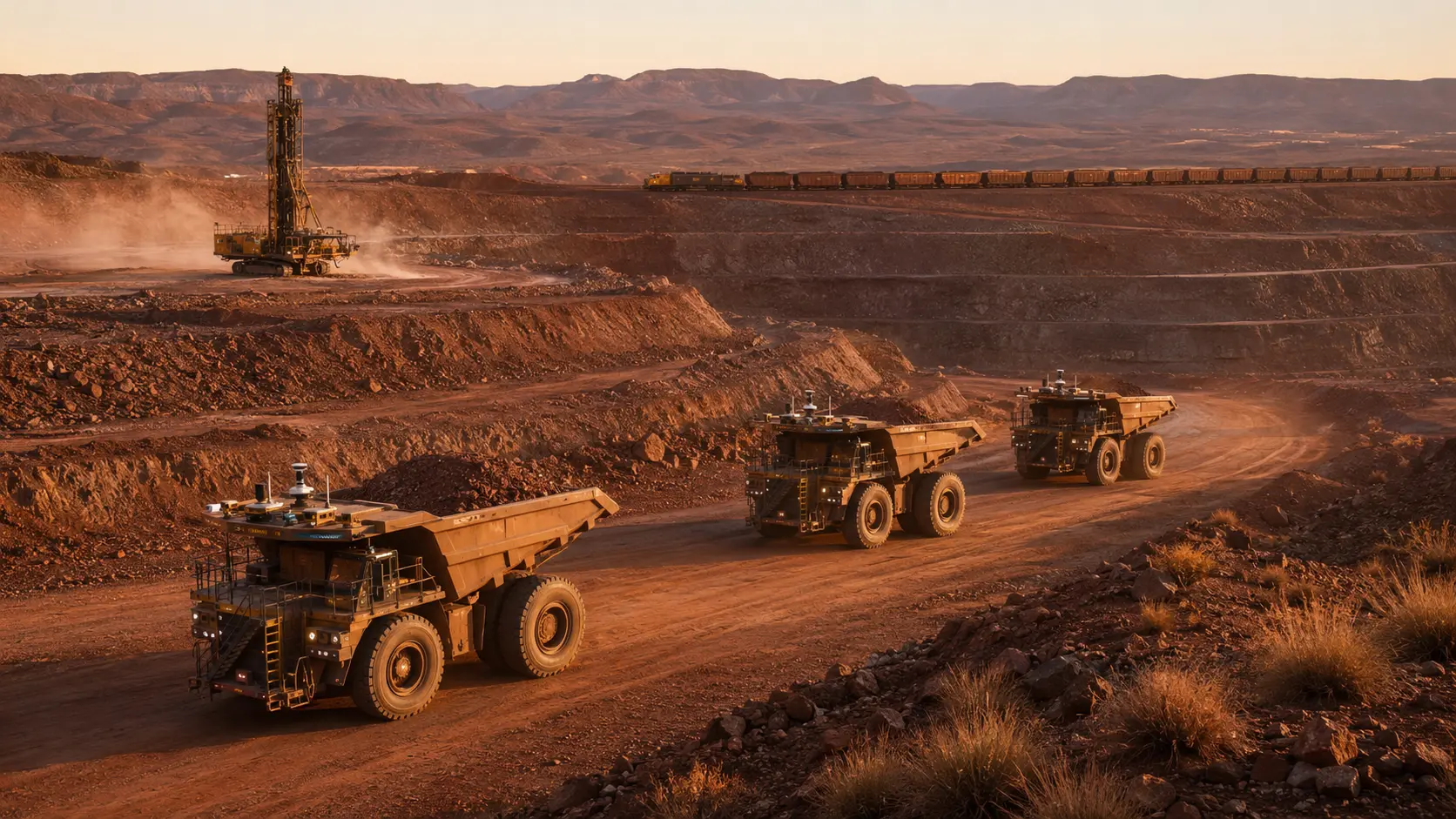
Automation operates across the whole system.
Rio Tinto's model links autonomous trucks and drills to processing, AutoHaul rail, port systems and a Perth Operations Centre. The technology can reduce exposure to some operational hazards while increasing reliance on maintainers, controllers, communications, data and systems specialists.
- AutoHaul railThe world's first fully autonomous heavy-haul rail network moves more than one million tonnes a day and removes substantial driver-transfer road travel.
- Autonomous miningApproximately 90% of the Pilbara haul fleet is autonomous, with 40 autonomous production drills operating across seven sites.
- Gudai-Darri systemsAutonomous water carts, a robotic laboratory, digital twin and paperless field operations extend automation beyond haulage.
- Electrification and steelBattery-electric haulage trials and customer partnerships are testing both lower-emissions mining and new pathways for Pilbara ore in steelmaking.
Workforce and technology watch
Latest Rio Tinto workforce and technology stories.
Selected for workforce, automation, technology, people and project relevance. Source-checked 30 August 2026.
Rio Tinto marks 60 years of Pilbara iron ore through its people
Rio Tinto marked six decades since its first Dampier shipment by recognising generations of employees, Traditional Owners, communities and suppliers that built the Western Australian iron ore system.
Workforce read
The milestone is a reminder that a highly automated system still depends on regional relationships, workforce knowledge and long-term capability across mines, rail, ports and support services.
OperationsMaintenanceRegional workforceSuppliers
Pilbara battery-electric haul truck trial passes 200 test laps
BHP, Rio Tinto, Caterpillar and WesTrac reported more than 100 operating hours and 200 test laps during early testing of two Cat 793 XE battery-electric haul trucks at Jimblebar.
Workforce read
The next phase includes dynamic charging. Scaling this technology would affect charging infrastructure, power management, mobile maintenance, control systems, operating procedures and the skills needed around haulage.
OperatorsHD fittersElectriciansControls engineers
Pilbara facilities contract keeps 2,250 regional service jobs in view
Rio Tinto awarded Sodexo a seven-year Pilbara facilities contract covering accommodation, catering, transport, aerodromes, cleaning, maintenance and other services across 25 villages and more than 19,000 FIFO rooms.
Workforce read
The release says the contract supports about 2,500 Sodexo jobs in WA, including around 2,250 in the Pilbara. FIFO work is broader than production and trades: villages, transport, aerodromes, retail and facilities maintenance are part of the operating system.
Village servicesFacilities maintenanceTransportAerodromes
Rio Tinto commits $100 million to Pilbara essential-worker housing
Rio Tinto announced a $100 million program intended to support more than 500 homes for essential-service workers across Pilbara communities including Karratha, Wickham, Tom Price, Paraburdoo and Roebourne.
Workforce read
Housing availability affects whether teachers, health workers, police and other essential staff can live in mining regions. Those services also support resident and FIFO workforces, making housing part of the wider labour system.
Essential workersRegional workforceHousing deliveryCommunity services
Sources & image register
Independent, sourced and explicit.
Operational and financial facts link to Rio Tinto's official operating pages, project releases and investor reporting. Map positions are approximate regional references.
Featured visuals are original AI-assisted editorial artwork created for The FIFO Hub. They are illustrative, not documentary photography. Official photography remains linked at source rather than republished without permission.
- 01Rio Tinto — Western Australia iron ore operations ↗
- 02Rio Tinto — 2026 half-year results ↗
- 03Rio Tinto — Results and investor archive ↗
- 04ASX — Rio Tinto market page ↗
- 05Rio Tinto — 60 years in Western Australia, 22 August 2026 ↗
- 06Rio Tinto — 8 billionth Pilbara tonne shipped, 20 May 2026 ↗
- 07Rio Tinto — battery-electric haul truck collaboration, 23 June 2026 ↗
- 08Rio Tinto — Pilbara Blend lower-emissions steel trials, 12 June 2026 ↗
- 09OpenStreetMap contributors — regional map reference ↗