Metallurgical coal
Coking coal and pulverised-coal-injection products are used in steelmaking. Quality characteristics and customer specifications influence processing, blending and terminal allocation.


Mine to market · Coal
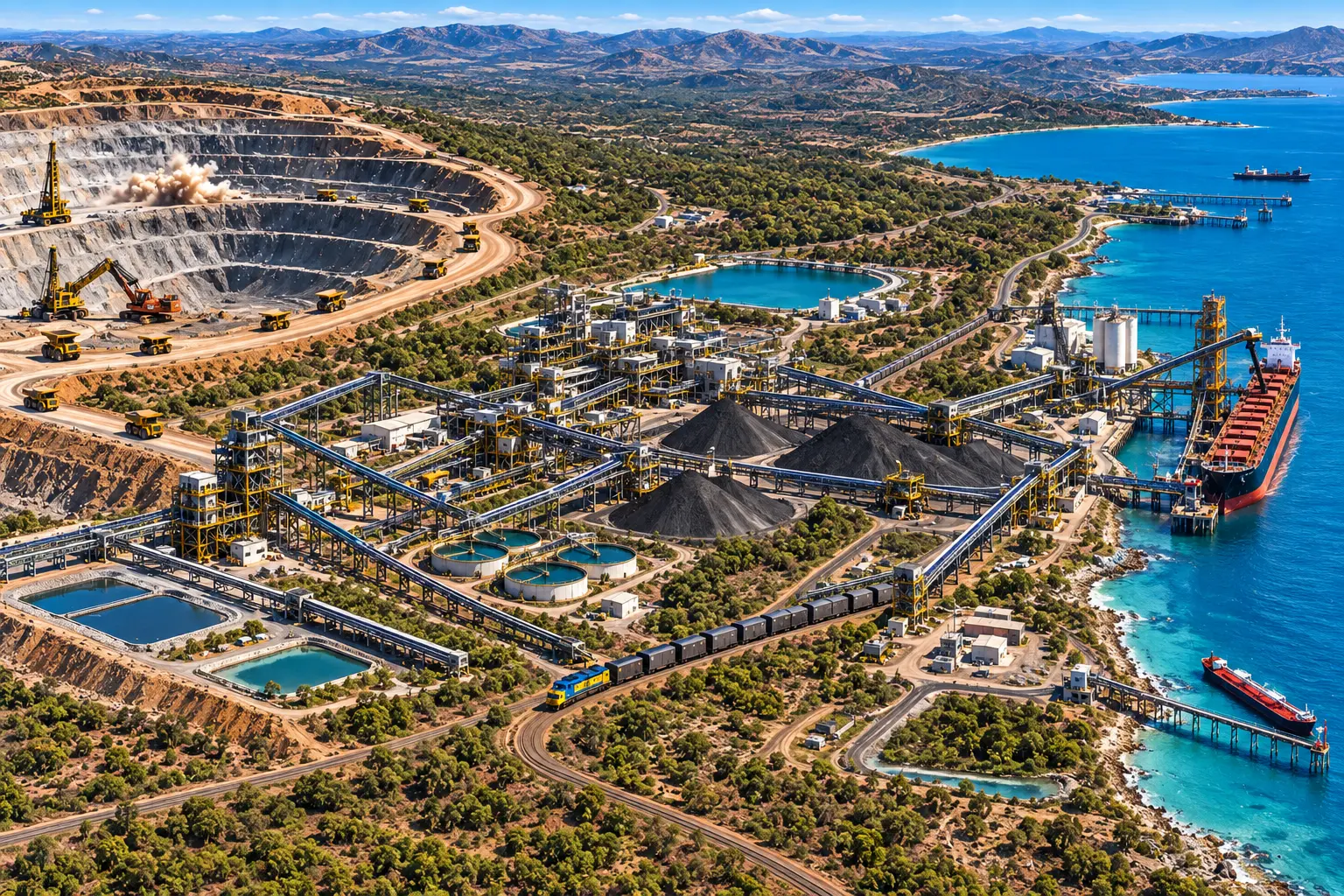
Follow a representative Australian coal chain through extraction, the coal handling and preparation plant, product stockpiles, heavy rail and an east-coast export terminal.
Follow the materialChoose a commodity
Iron ore is the original pit-to-port system. Coal, lithium and gold follow different processing, transport and customer pathways.
Why the route changes
Coal can be mined by open-cut or underground methods and sold into metallurgical or thermal markets. Raw coal commonly passes through a coal handling and preparation plant (CHPP), where crushing, sizing, washing and dewatering produce customer-ready streams. Product coal then moves through shared rail and terminal networks rather than one operator-owned Pilbara system.
Read the handovers: the useful question is not only “what machine is next?” It is what product leaves each stage, what quality information travels with it and which downstream system is ready to receive it.
Products and markets
Mine design, ore characteristics, customer specification and local infrastructure determine the actual route.
Coking coal and pulverised-coal-injection products are used in steelmaking. Quality characteristics and customer specifications influence processing, blending and terminal allocation.
Thermal coal is primarily supplied for energy generation and industrial heat. Export and domestic routes vary by basin, mine and contract.
One operation may produce more than one saleable coal product. Sampling, laboratory results, stockpile identity and blending decisions remain important through the chain.
The operating chain
A representative Australian pathway. Individual mines and products can add, remove or reorder stages.
Open-cut fleets remove overburden and recover exposed seams; underground operations can use continuous miners or longwall systems. Geological control and selective mining protect product quality.
Run-of-mine coal delivered to a ROM stockpile or plant feed system.
The CHPP receives raw coal, reduces and separates size fractions, removes reject material and dewaters product. Dense-medium and flotation circuits may be used depending on the coal and plant.
Separated, dewatered coal streams meeting the site's product plan.
Product conveyors feed defined stockpiles. Sampling, laboratory testing, moisture control and blending decisions support traceability and customer specification.
A nominated product parcel ready for train loading or a domestic customer.
Train load-out systems place product into wagons for movement across multi-user coal networks. Some routes include a road-haul leg before rail or direct delivery.
A documented train consist accepted into the rail network.
Export terminals unload trains, sample coal and transfer it to customer- or cargo-specific stockpiles. Shared terminals coordinate many mines, rail operators and vessel schedules.
Coal positioned in the terminal stockyard for the nominated vessel parcel.
Reclaimers recover the planned parcel and conveyors deliver it to the berth. Shiploaders distribute coal through the vessel holds under terminal and marine controls.
Saleable coal loaded aboard the nominated vessel or delivered to a domestic user.
Australian examples
These are high-level, public examples—not site procedures, haulage instructions or complete product-routing diagrams.
Mines connect through the Central Queensland Coal Network to major terminals including Hay Point, Dalrymple Bay, Gladstone and Abbot Point. The exact route depends on mine access and terminal contracts.
Whitehaven Coal profileProduct coal from Hunter and Gunnedah basin operations moves by rail to Newcastle terminals, where trains are unloaded, coal is stockpiled and vessels are loaded for export.
Yancoal Australia profileWhitehaven operates underground and open-cut mines in the region. Product preparation and shared rail infrastructure connect the basin with the Newcastle export system.
Whitehaven Coal profilePeople behind the chain
Sources and further reading
Checked 30 August 2026. External links open the primary source.
Official overview of the multi-user rail systems connecting more than 50 mines with five export terminals and domestic customers.
Operator overview of the multi-user metallurgical-coal terminal at the Port of Hay Point.
Official information on the Carrington and Kooragang coal terminals at Newcastle.
Terminal explanation of inbound train unloading, stockyards and outbound shiploading.
Current operator list covering Whitehaven's NSW and Queensland coal operations.
Current overview of Yancoal's producing mines and infrastructure interests across Australia.
Technical boundary: Coal characteristics, CHPP circuits, spontaneous-combustion controls, gas management, dust controls, train plans and terminal procedures are operation-specific. Use approved site procedures, competent supervision and current plant documentation.