Gold-silver doré
A semi-refined bar poured at the mine after recovery and smelting. Doré composition varies and is determined through sampling, weighing and assay before final refining.


Mine to market · Gold
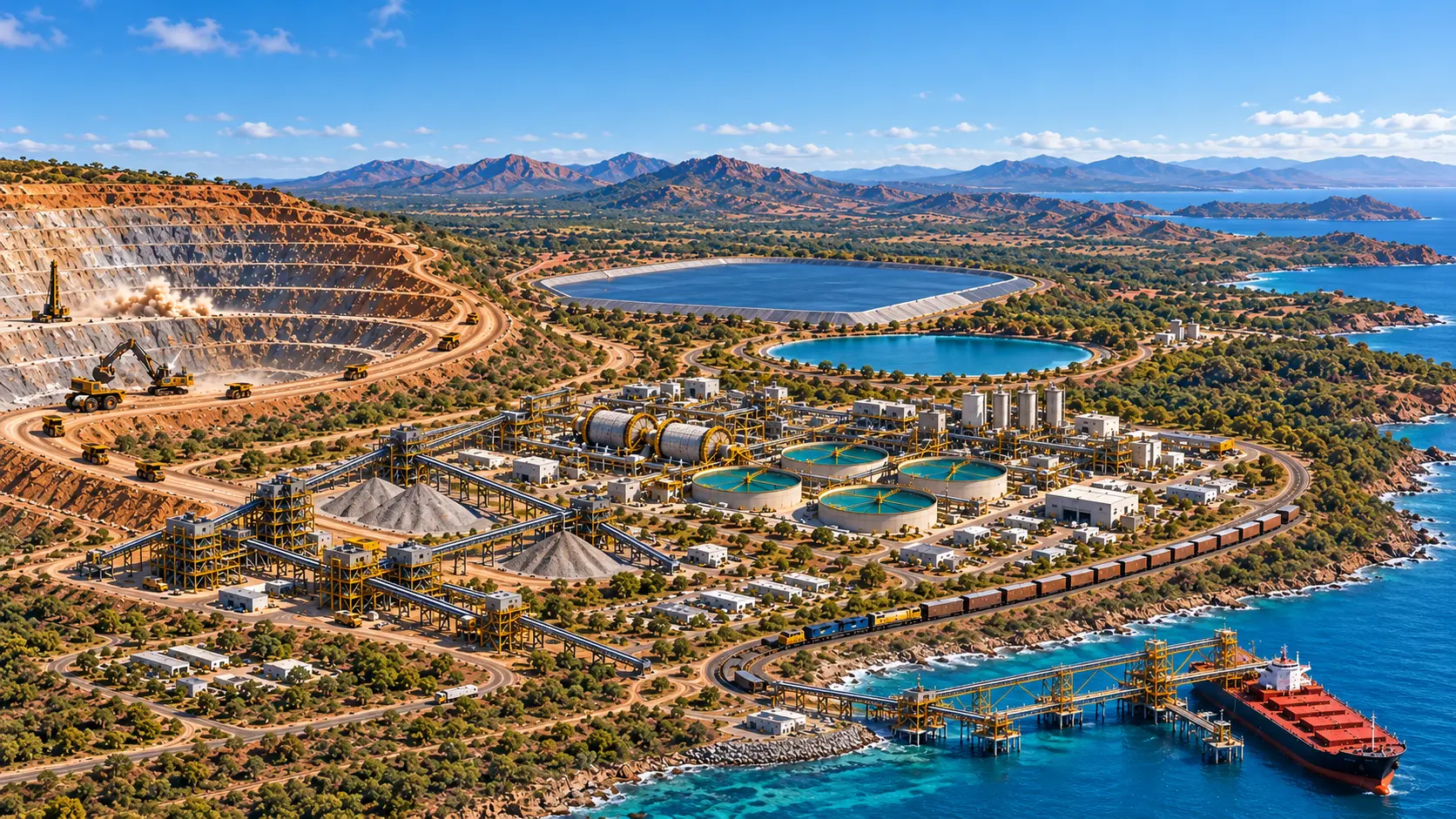
Follow a representative Australian gold route through open-pit or underground mining, comminution, recovery, doré production, secure transport and precious-metal refining.
Follow the materialChoose a commodity
Iron ore is the original pit-to-port system. Coal, lithium and gold follow different processing, transport and customer pathways.
Why the route changes
Gold is a high-value, low-volume product. Most gold operations do not need a heavy-haul railway, giant stockyard or shiploader. Ore is processed near the mine, and the recovered metal commonly leaves as gold-silver doré under controlled security for assay and refining. Some gold-copper mines instead produce a concentrate for export and smelting.
Read the handovers: the useful question is not only “what machine is next?” It is what product leaves each stage, what quality information travels with it and which downstream system is ready to receive it.
Products and markets
Mine design, ore characteristics, customer specification and local infrastructure determine the actual route.
A semi-refined bar poured at the mine after recovery and smelting. Doré composition varies and is determined through sampling, weighing and assay before final refining.
A refinery separates and purifies precious metals to recognised specifications. Refined metal can become investment bars, minted products or industrial material.
Some polymetallic operations recover gold into a copper-rich concentrate. That route uses dewatering, covered transport, port handling and smelting rather than a mine-site doré-only chain.
The operating chain
A representative Australian pathway. Individual mines and products can add, remove or reorder stages.
Open-pit or underground crews recover ore according to grade-control and geotechnical plans. Selectivity matters because gold can be measured in only a few grams per tonne of rock.
Identified ore delivered to the ROM pad, crusher or underground ore-handling system.
Crushers and mills reduce particle size so the plant can expose gold-bearing minerals. The circuit depends on ore hardness, mineralogy and the selected recovery method.
A controlled slurry or sized stream ready for gold recovery.
Gravity concentration can recover liberated coarse gold. Many plants then use carbon-in-leach or carbon-in-pulp circuits to recover dissolved gold, while refractory ores may need additional treatment.
Gold captured in gravity concentrate or loaded onto activated carbon.
Gold is stripped from loaded carbon and recovered from solution through electrowinning. The resulting sludge or concentrate is prepared for controlled smelting.
A high-grade precious-metal product ready for the gold room.
The gold room smelts recovered metal and pours doré bars. Weighing, sampling, assay, reconciliation and security controls account for the high-value product.
Sealed and documented doré accepted into secure transport.
An accredited refinery receives doré, confirms metal content and separates gold and silver to the required purity. Refined products then enter bullion, manufacturing and investment markets.
Refined precious metal produced to an accepted specification.
Australian examples
These are high-level, public examples—not site procedures, haulage instructions or complete product-routing diagrams.
Open-pit and underground ore feeds Northern Star's Fimiston and Gidji processing plants. The large mining-and-milling system ultimately produces a compact, high-value precious-metal output.
Northern Star profileNewmont's underground ore is trucked to the Granites processing plant for crushing, grinding, gravity recovery and carbon-in-leach processing before the precious-metal route continues.
Newmont Australia profileMine doré can move by secure transport to a refinery such as The Perth Mint, where assay and refining produce high-purity gold for bullion and manufactured products.
Northern Star profilePeople behind the chain
Workforce readiness
Employment screening and the physical work environment are separate from technical process knowledge.
Understand the exact check, accepted issuer, point-in-time validity, privacy and secure mobilisation process.
Open guide →Work environmentCompare access, equipment, ventilation, ground control, emergency systems, shift travel and transferable experience.
Open guide →Sources and further reading
Checked 30 August 2026. External links open the primary source.
Operator overview of the Super Pit, underground mines and Fimiston and Gidji processing plants.
Current overview of the Kalgoorlie and Yandal production centres and their operating sites.
Operator explanation of underground mining and the crushing, grinding, gravity and carbon-in-leach route at the Granites plant.
Current company overview of Boddington, Cadia and Tanami.
Government-owned refiner explanation of transforming mine doré into high-purity gold and manufactured precious-metal products.
Refiner guidance on accreditation, assay, security and responsible sourcing considerations.
Technical boundary: Gold recovery uses hazardous chemicals, high-temperature equipment and high-value security systems. This guide is conceptual only and does not replace approved cyanide-management, isolation, gold-room, security, assay or refinery procedures.