Spodumene concentrate
A mineral concentrate made by rejecting waste and upgrading lithium-bearing spodumene. Grade, moisture, particle size and impurity limits matter to the customer and converter.


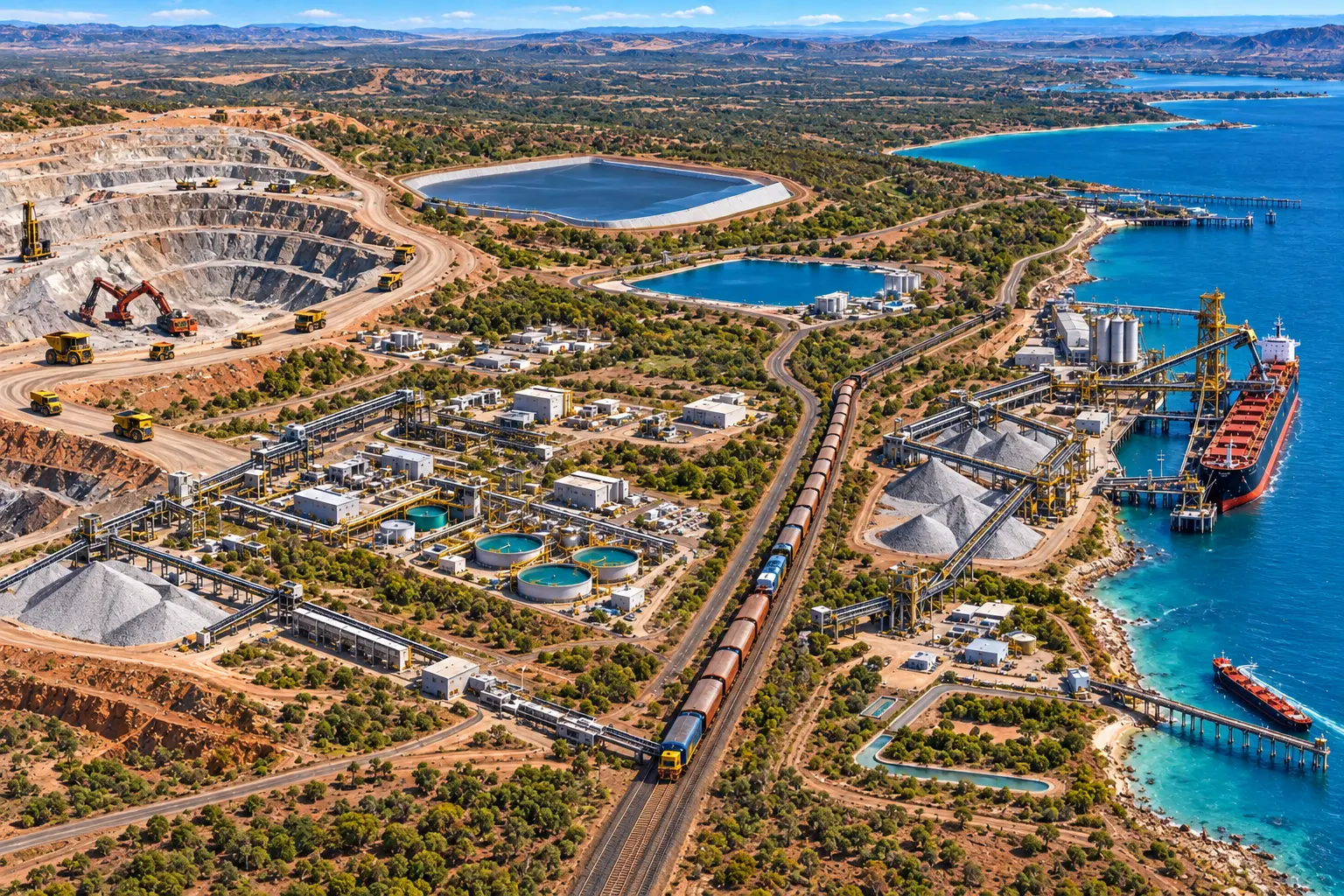
Mine to market · Lithium
Follow a representative Western Australian hard-rock lithium route through mining, ore sorting, concentration, road haul, port export and downstream chemical conversion.
Follow the materialChoose a commodity
Iron ore is the original pit-to-port system. Coal, lithium and gold follow different processing, transport and customer pathways.
Why the route changes
Australia's dominant lithium route starts with hard-rock pegmatite ore and commonly produces spodumene concentrate. Unlike Pilbara iron ore, the concentrate may travel by road in covered bulk haulage to a port, then ship to a chemical converter. The converter—not the mine—may produce lithium hydroxide or carbonate for cathode and battery manufacturers.
Read the handovers: the useful question is not only “what machine is next?” It is what product leaves each stage, what quality information travels with it and which downstream system is ready to receive it.
Products and markets
Mine design, ore characteristics, customer specification and local infrastructure determine the actual route.
A mineral concentrate made by rejecting waste and upgrading lithium-bearing spodumene. Grade, moisture, particle size and impurity limits matter to the customer and converter.
Chemical conversion adds calcination, leaching, purification and crystallisation stages. Conversion can occur in Australia or overseas and is not present at every mine.
Some deposits also contain saleable tantalum or other mineral streams. Coarse rejects, tailings and water are managed within the site's approved process and environmental systems.
The operating chain
A representative Australian pathway. Individual mines and products can add, remove or reorder stages.
Open-pit or underground mining selectively recovers lithium-bearing pegmatite while controlling dilution and ore loss. Grade control directs ore and waste to the correct destinations.
Run-of-mine lithium ore delivered to the crusher or ROM stockpile.
Crushing reduces the ore to the size required by the concentrator. Some operations use ore sorting or screening to reject barren material before energy-intensive downstream treatment.
Prepared feed with controlled size and reduced waste content.
Dense-medium separation, grinding and flotation can upgrade spodumene, with the flowsheet selected for the orebody. Water balance and recovery are central plant considerations.
A lithium-rich concentrate stream separated from rejects and tailings.
Concentrate is thickened, filtered and placed into controlled storage before dispatch. Sampling and laboratory results support product acceptance and shipment documentation.
Spodumene concentrate within dispatch moisture and quality requirements.
Dedicated road haulage can move concentrate from inland operations to port storage. Port arrangements then receive, store and load the product for shipment to contracted customers.
A traceable concentrate cargo transferred into the maritime supply chain.
Converters transform spodumene into refined lithium chemicals. Those chemicals move into cathode-active material, cell manufacture, battery packs and end uses such as vehicles and stationary storage.
Battery-grade chemical supplied into a qualified manufacturing chain.
Australian examples
These are high-level, public examples—not site procedures, haulage instructions or complete product-routing diagrams.
PLS mines and concentrates hard-rock lithium near Port Hedland. Dedicated road haulage moves spodumene concentrate to port storage and shipping; company offtake also connects product with downstream conversion.
PLS (Pilbara Minerals) profileLiontown's underground operation produces spodumene concentrate north of Leinster. Sealed highways connect the site to the Port of Geraldton for delivery to customers.
Liontown profilePeople behind the chain
Sources and further reading
Checked 30 August 2026. External links open the primary source.
Operator explanation of crushing and ore sorting within the Pilgangoora expansion pathway.
Operator account of dedicated road transport from Pilgangoora to Port Hedland for storage and shipping.
Operator explanation of planned port infrastructure supporting Pilgangoora's export requirements.
Primary source connecting Pilgangoora spodumene concentrate with lithium-hydroxide conversion in Korea.
Current operation overview, underground mining context and transport connection to Geraldton.
Technical boundary: Lithium mineralogy, DMS and flotation response, reagent systems, product specifications, transport controls and chemical-conversion parameters vary by orebody, plant and customer. Use current metallurgical testwork, approved procedures and product contracts.