
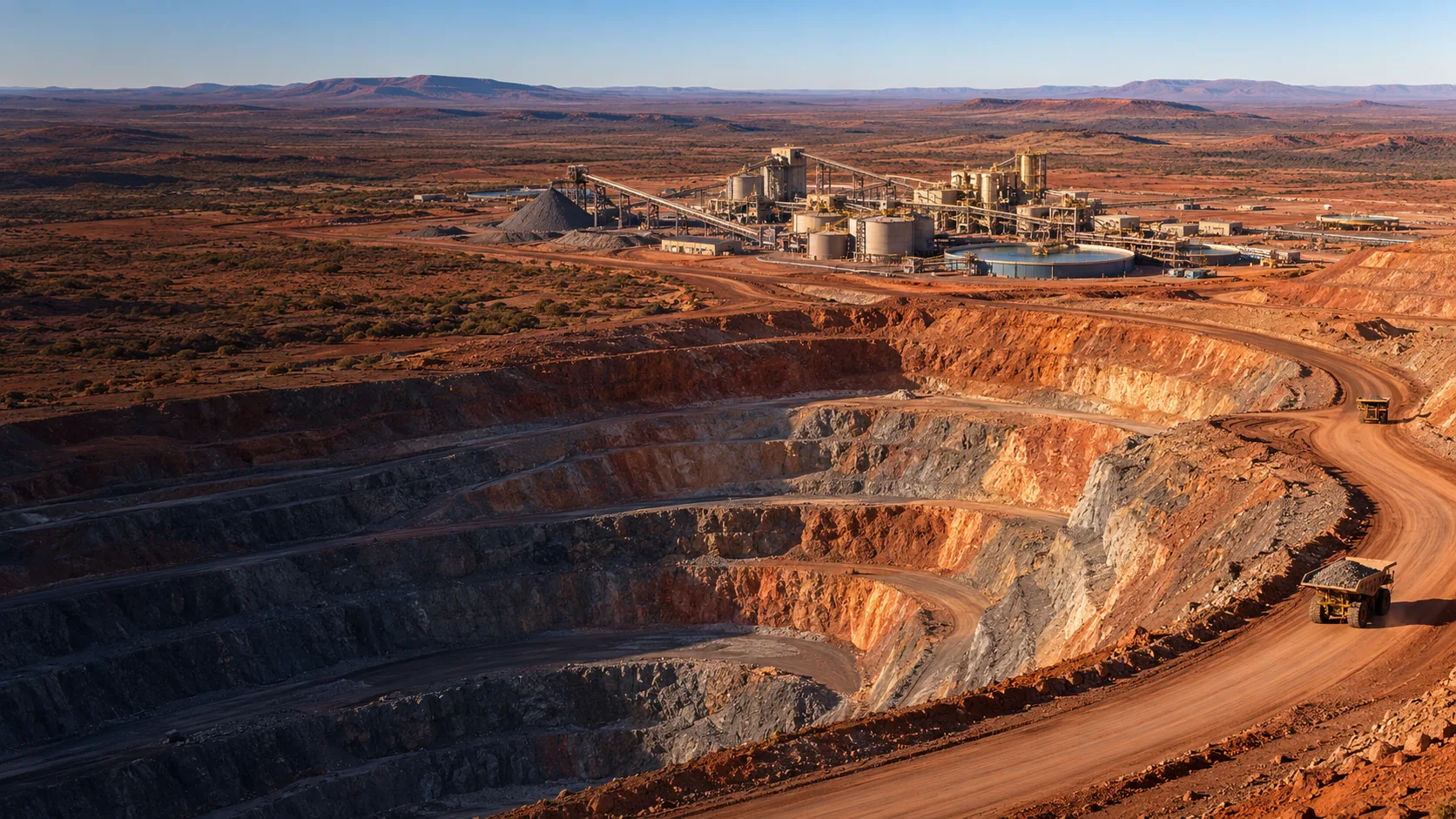
Conceptual Australian copper mine and processing plant

Australian mining equipment · copper

Copper equipment.
Ore to cathode.

Read the duty, handover, maintenance focus and people behind six connected equipment families.

Open the equipment system

Choose a commodity

One equipment library. Five different systems.

Compare machines used in iron ore, coal, lithium, gold and copper—from extraction to the final product handover.

Read the whole system

Each machine changes the next handover.

Mining method and ore type set the equipment route. A concentrator may sell concentrate for off-site smelting, while an integrated operation can produce copper cathode. The sequence below describes a representative sulfide-ore pathway; leach and SX–EW circuits are alternatives for suitable ores.

Follow the full copper process and FIFO roles →
01 · Extraction

Underground and open-pit mining fleets

Recover the planned copper ore and keep its identity through the first handover.

InputMapped orebody and an approved mine plan
Equipment dutyRecover the planned copper ore and keep its identity through the first handover.
OutputRun-of-mine ore at a crusher, ore pass or stockpile

How it works

Orebody geometry determines the mine method. Surface operations combine production drills, loading units and haul trucks. Underground operations add ground support, ventilation, dewatering and ore handling; some use rail or hoists to reach the surface.

People

Miners, drillers, operators, HD fitters, auto electricians, geologists and surveyors.

Major systems

  • Drills, charging and ground support
  • LHDs, excavators and haul trucks
  • Ventilation, pumping and power
  • Grade control, dispatch and survey

Maintenance focus

  • Ground-engaging tools, booms and hydraulics
  • Brakes, tyres, powertrain and cooling
  • Ventilation fans, pumps and electrical distribution

Watch: Ground conditions, mobile-equipment interactions and ore dilution.

02 · Comminution

Crushers, mills and classification

Reduce rock and liberate copper-bearing minerals for recovery.

InputVariable-sized run-of-mine ore
Equipment dutyReduce rock and liberate copper-bearing minerals for recovery.
OutputA controlled slurry at the target grind

How it works

Feeders meter ore into crushing. SAG and ball mills, pumps and hydrocyclones operate as a circuit, recirculating coarse material while sending correctly sized slurry to flotation. Actual equipment and grind targets follow testwork.

People

Crusher and mill operators, mechanical fitters, electricians, E&I technicians, relining crews and metallurgists.

Major systems

  • ROM bins, feeders and crushers
  • SAG and ball mills with liners and drives
  • Cyclones, sumps and slurry pumps
  • Sampling and control instrumentation

Maintenance focus

  • Crusher liners, bearings and lubrication
  • Mill liners, drives and relining access
  • Pump wet ends, cyclone liners and pipework

Watch: Blockage, abrasive wear, energy use and unstable grind size.

03 · Concentration

Flotation and reagent systems

Separate copper sulfide minerals into a copper-rich concentrate.

InputClassified slurry and approved reagent program
Equipment dutySeparate copper sulfide minerals into a copper-rich concentrate.
OutputConcentrate slurry and a tailings stream

How it works

Conditioned slurry passes through flotation cells. Air bubbles carry selected minerals into a froth that is recovered; scavenger and cleaner stages may improve recovery or grade. Sensors and laboratory assays guide decisions.

People

Process operators, metallurgists, laboratory technicians, E&I technicians, fitters and control-room operators.

Major systems

  • Flotation cells, agitators and air
  • Reagent storage and dosing
  • Froth handling and launders
  • Analyzers, samplers and DCS controls

Maintenance focus

  • Rotor and stator wear
  • Blowers, pumps and valves
  • Instrumentation, probes and reagent containment

Watch: Chemical exposure, froth instability, metal recovery and tailings routing.

04 · Dewatering

Thickeners, filters and product handling

Prepare a measured concentrate for contained transport or smelter feed.

InputCopper concentrate slurry
Equipment dutyPrepare a measured concentrate for contained transport or smelter feed.
OutputFiltered concentrate, recovered water and product records

How it works

A concentrate thickener increases solids content, then a filter removes further water. Sampling, weighing, containment and traceability support the product handover. Transport can be by road, rail or other project-specific infrastructure.

People

Filter operators, fitters, electricians, product-quality technicians and logistics teams.

Major systems

  • Concentrate thickeners and rake drives
  • Pressure or vacuum filters
  • Conveyors, bins and covered storage
  • Sampling, weighing and water return

Maintenance focus

  • Rake torque, drive and underflow pumps
  • Filter cloths, plates, hydraulics and seals
  • Conveyor wear, dust collection and washdown

Watch: Moisture specification, spillage and concentrate containment.

05 · Smelting

Furnaces, converters and gas systems

Turn suitable copper concentrate into an intermediate metal product while managing slag and process gas.

InputAccepted copper concentrate and route-specific fluxes
Equipment dutyTurn suitable copper concentrate into an intermediate metal product while managing slag and process gas.
OutputBlister copper or anode feed for refining

How it works

A smelter uses high-temperature reactions to separate copper-bearing molten material from slag. Converting further removes sulfur and iron. Off-gas capture and acid systems are integral to the plant, where fitted.

People

Smelter operators, refractory teams, boilermakers, mechanical and electrical trades, process engineers and control-room operators.

Major systems

  • Smelting furnace and refractory
  • Converters, ladles and cranes
  • Gas capture and acid plant
  • Cooling, power and process control

Maintenance focus

  • Refractory and furnace integrity
  • Cranes, lifting equipment and hot-metal handling
  • Ducting, fans, cooling and gas-system integrity

Watch: Molten metal, high heat, sulfur dioxide and gas containment.

06 · Refining

Electrorefining and copper cathode

Refine copper to a saleable cathode product and account for other valuable metals.

InputCopper anodes or route-specific purified solution
Equipment dutyRefine copper to a saleable cathode product and account for other valuable metals.
OutputCopper cathode to the required specification

How it works

In electrorefining, impure anodes dissolve in electrolyte and copper deposits on cathode starter sheets or plates. Solvent extraction and electrowinning is a different pathway for suitable leached ores. Both need disciplined electrical, chemical and product-quality systems.

People

Refinery operators, E&I technicians, mechanical fitters, metallurgists, laboratory staff and product teams.

Major systems

  • Electrolytic cells and rectifiers
  • Electrolyte circulation and treatment
  • Anode and cathode handling
  • Assay, weighing and dispatch

Maintenance focus

  • Busbars, contacts and rectifiers
  • Pumps, tanks, pipework and corrosion control
  • Handling equipment and ventilation

Watch: Acid and electrical hazards, product purity and metal accounting.

Sources and boundaries

Illustrative equipment, site-specific duty.

Checked 28 September 2026. Operating limits and inspection criteria come from the current site and OEM documents.

Technical boundary: This is conceptual learning content, not a site flowsheet, isolation instruction or OEM drawing. Sulfide flotation, oxide leaching, smelting and electrorefining use different hazards and controls.